Foxhall Clifford
The King in YellowFoxhall Clifford is an artist and a socially agile figure in Paris whose lightness, courtesy, and impulsiveness repeatedly conceal serious emotional stakes. He appears first as a stranger whom Hastings fails to recognize because Clifford has sacrificed his moustache to satisfy a friend’s whim; yet behind the disguise is a man sufficiently established to offer Hastings a studio sponsorship. His decisive importance lies in the contrast between his playful public manner and the gravity with which he can suddenly pledge his entire life to another person.
Identity and Social Presentation
Clifford is introduced through comic misrecognition. Hastings encounters him near the fountain after Clifford’s dog has escaped the efforts of a policeman and three gardeners, finally disappearing in the rue de Medici. Clifford explains that the dog is his, that it enjoys the novel sport of playing tag with policemen, and that it has gone home after the gardeners intervened. The incident presents him as amused by disorder rather than embarrassed by it, while his moustache supplies a second layer of theatrical self-presentation: he attributes Hastings’s failure to recognize him to the fact that he sacrificed it for a friend’s whim.
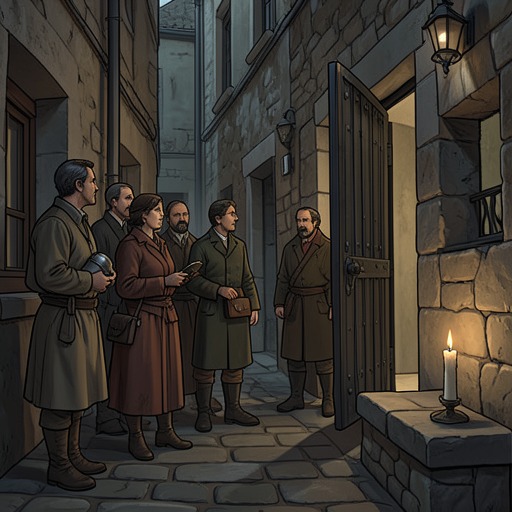
His manners remain polished even amid this absurdity. Clifford bows, removes his hat with a confused smile when he sees a girl approaching, and speaks with the formal ease of a man accustomed to social performance. He is also attentive to professional connections. After learning of Hastings through Reverend Joel Byram, he says that Richard Osborne Elliott and he will gladly help him, and he offers to stand as Hastings’s sponsor at the studio. His cultivated generosity therefore coexists with a restless, mischievous temperament.
Artistic and Domestic Position
Clifford’s identity is linked to the studio as both workplace and home. After crossing the street and passing through an ivy-covered alley, he enters his garden and approaches the studio door. There he finds two cards tacked over the panels, one bearing his own name and the other Richard Osborne Elliott’s. The paired names make Elliott not a casual visitor but a permanent companion within Clifford’s domestic and artistic world.
This setting also clarifies the divided nature of Clifford’s life. The garden and studio suggest an enclosed creative household, while the fountain plaza, cafés, trains, and streets of Paris provide the fluid social world in which he moves. His attention is habitually divided between appointments and encounters: he repeatedly checks his watch, announces that he has only ten minutes to catch the Versailles train, and nevertheless pauses when the approaching girl claims his attention. Practical schedules yield almost immediately to emotional or social impulse.
Encounter with Rue Barrée
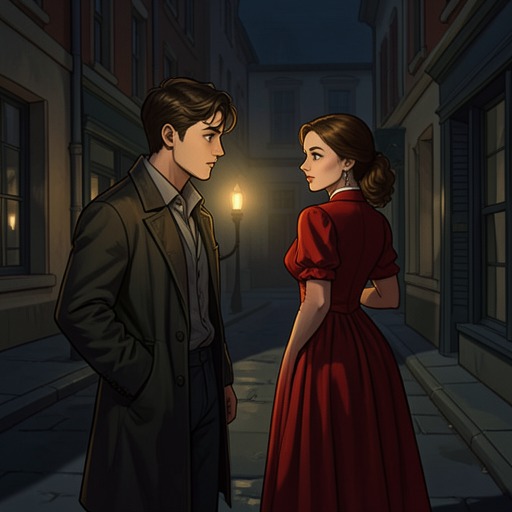
Clifford receives the girl in a private room after she arrives with an attendant. He opens the door for her, permits the garçon to take her jacket, hat, and umbrella, and sits opposite her at a small table while she leans forward and looks directly into his face. The arrangement is intimate but controlled, and her clear gaze makes the encounter more serious than Clifford’s earlier banter with Hastings.
Her directness unsettles him. When she raises the question of discretion, her eyes remain very clear, and Clifford winces, though only briefly. He then allows what the narrative calls the devil of recklessness to seize him and offers himself to her completely, including his soul, body, goods, and chattels. The intensity of the gesture is not presented as settled romantic wisdom. Clifford knows while speaking that he is being foolish; he also recognizes that infatuation is not love and that each word binds him by honour to a commitment from which escape will be impossible.
The proposal is consequently both sincere and self-diagnosed. Clifford does not mistake his emotional condition for certainty. He understands that ardour can manufacture its own obligations, yet he continues speaking because the knowledge of his error does not overcome the force of his desire. His romantic action is therefore driven by a conflict between reflective judgment and impulsive surrender rather than by simple confidence.
Relationships and Conflict
Richard Osborne Elliott functions as Clifford’s intimate counterpart and reluctant protector. While Clifford makes his offer, Elliott watches from the fountain plaza and scowls, savagely restraining both bulldogs whenever they want to rush to Clifford’s rescue. The dogs’ agitation mirrors Elliott’s inward anger: he senses that something is wrong and growls maledictions while Clifford proceeds. Elliott’s reaction establishes a protective loyalty that Clifford, absorbed in his proposal, cannot or will not heed.
Clifford’s earlier interaction with Hastings shows a different relational mode. He is open, hospitable, and professionally encouraging, offering assistance before intimacy has been established. With Rue Barrée, however, his courtesy becomes total self-commitment. The contrast reveals the scale of the shift: he moves from sponsoring another artist to offering marriage, from sociable helpfulness to an irreversible declaration.
Rue Barrée does not answer his ardour with matching enthusiasm. After Clifford finishes, excitement leaves him as her silence allows the situation to assume its proper proportions. Regret begins to approach, but he suppresses it and resumes his protestations until she stops him. Her response is grave: she tells him that no man has ever before offered her marriage, acknowledges that he offers her a great deal, and describes herself as alone, possessing nothing and being nothing. Her refusal to treat the proposal as a romantic game forces Clifford’s grand gesture into the realm of real consequence.
Change and Narrative Significance
Clifford’s key movement is from comic mobility to binding commitment. At first he is defined by changing appearances, an eccentric dog, interrupted plans, and easy conversation. The same man who treats a chase through Paris as entertainment later recognizes that his words have created an honourable obligation. His transformation is not a complete maturation or a confirmed triumph of love; it is a sudden exposure of the cost hidden inside his own recklessness.
The character is round rather than flat because his apparent frivolity contains a convincingly serious counterforce. He can be playful about the dog, self-mocking about the missing moustache, generous toward Hastings, attentive to social ceremony, and yet capable of offering his entire person in a moment of emotional crisis. These qualities are not reconciled into a stable identity. Instead, the narrative lets them collide, making his proposal both ridiculous in its haste and morally weighty in its consequences.
Clifford also embodies the instability of romantic performance. He enters the encounter as a man practiced in gesture—bowing, removing his hat, arranging the meeting, and speaking with confidence—but Rue Barrée’s clear eyes expose the difference between performing a role and accepting the obligations that role entails. His recklessness is thus not merely a personal weakness; it is the mechanism by which social charm turns into a binding act. Through Clifford, the narrative gives romantic desire an unsettling double image: it is at once theatrical, self-aware, impulsive, and capable of changing the terms of two lives.